
Model itinerary (based on research) — This plan was built from official sources listed at the end of the article. It is a researched model itinerary, not a visit report.
Yufuin and Beppu are Kyushu’s two most famous hot-spring towns, less than an hour apart in Oita Prefecture — close enough that many visitors try to squeeze both into a single day. This plan does the opposite. It gives Yufuin a full day and a night, because the best hour in Yufuin belongs to the people who sleep there, then moves on to Beppu for an afternoon among the steaming “Hells” and the old tōji (hot-spring cure) streets of Kannawa. Both towns are popular, and this plan will not pretend otherwise. What it does is put you in each place at the hours when it is most itself.
At a Glance
- Duration: 2 days, 1 night (an extra Beppu night can be added at the end)
- Start / finish: Hakata Station, Fukuoka → Yufuin (night 1) → Beppu → Hakata (or onward)
- Main transport: JR limited express (Yufuin no Mori / Yufu) from Hakata; local bus or limited express between Yufuin and Beppu; walking and city buses inside each town
- Walking: Moderate — Yufuin is walked end to end (station to lake about 25 minutes each way); the Hells add short walks and bus rides
- Best seasons: Late autumn to winter, when steam rises off Lake Kinrin on cold mornings and Beppu’s yukemuri shows best in cold air. Summer is hot and humid around the Hells
- Crowd tactic, honestly stated: Sleep in Yufuin. Day-trip visitors fill Yunotsubo Street from late morning to mid-afternoon; overnight guests get the lake before they arrive and the street after they leave. In Beppu, choose a few Hells rather than racing all seven, and save Kannawa for the end of the day. A weekday helps. None of this empties either town — it changes which hours you share with the crowds
Who this suits / who it may not: This suits a first onsen-focused Kyushu trip, and anyone travelling without a car. It may not suit travellers who want to add Aso or Kurokawa on the same trip (each deserves its own days), or anyone hoping to bathe in the Hells: the Hells are for viewing, not bathing.
Why Visit Yufuin and Beppu
The two towns are a study in contrasts.
Yufuin is a basin town, spread across a flat valley floor beneath the twin peaks of Mount Yufu, with rice fields and low lanes between its ryokan, and one main street — Yunotsubo Kaidō — running from the station toward Lake Kinrin. Its hot-spring culture is the culture of the inn: small properties, garden baths, dinner in your room or a quiet dining room. Busy at midday, it settles again in the evening.
Beppu is a city built on steam. Columns of yukemuri rise between ordinary houses, and the springs are part of the town’s daily life rather than a resort enclave. Beppu counts its spring sources and its total output among the largest in Japan. The most atmospheric of its eight traditional bathing areas (the Beppu Hattō) for a short visit is Kannawa, uphill from the station, where steam drifts across stone lanes that still feel like the old tōji quarters.
And then there are the Hells. The jigoku are springs too hot and too theatrical for bathing — a cobalt-blue pond, a blood-red pond, bubbling mud, a geyser — which people have travelled to look at for over a century. They are the opposite of the quiet bath at your inn, and that is why they belong in the same trip: raw geothermal power first, then its gentler form at the end of the day.
The Itinerary
Times below are a guide, not a promise — trains and buses will move them around.
Day 1: Yufuin — the Street, the Lake, and a Slow Afternoon
Morning — ride the Yufuin no Mori. The plan is built around the first departure from Hakata: Yufuin no Mori No. 1 leaves Hakata at 09:17 and reaches Yufuin at 11:31 (timetable as of January 2026 — check your date). Every seat is reserved, and JR Kyushu warns that seats are consistently fully booked day after day — secure this ticket the day reservations open, a month ahead (see Getting There). The ride is part of the trip: wood-panelled cars, a bar counter, and the Minou mountains giving way to the Yufuin basin. (Yufuin Station even has a footbath on Platform 1, for any waiting you do there later.)
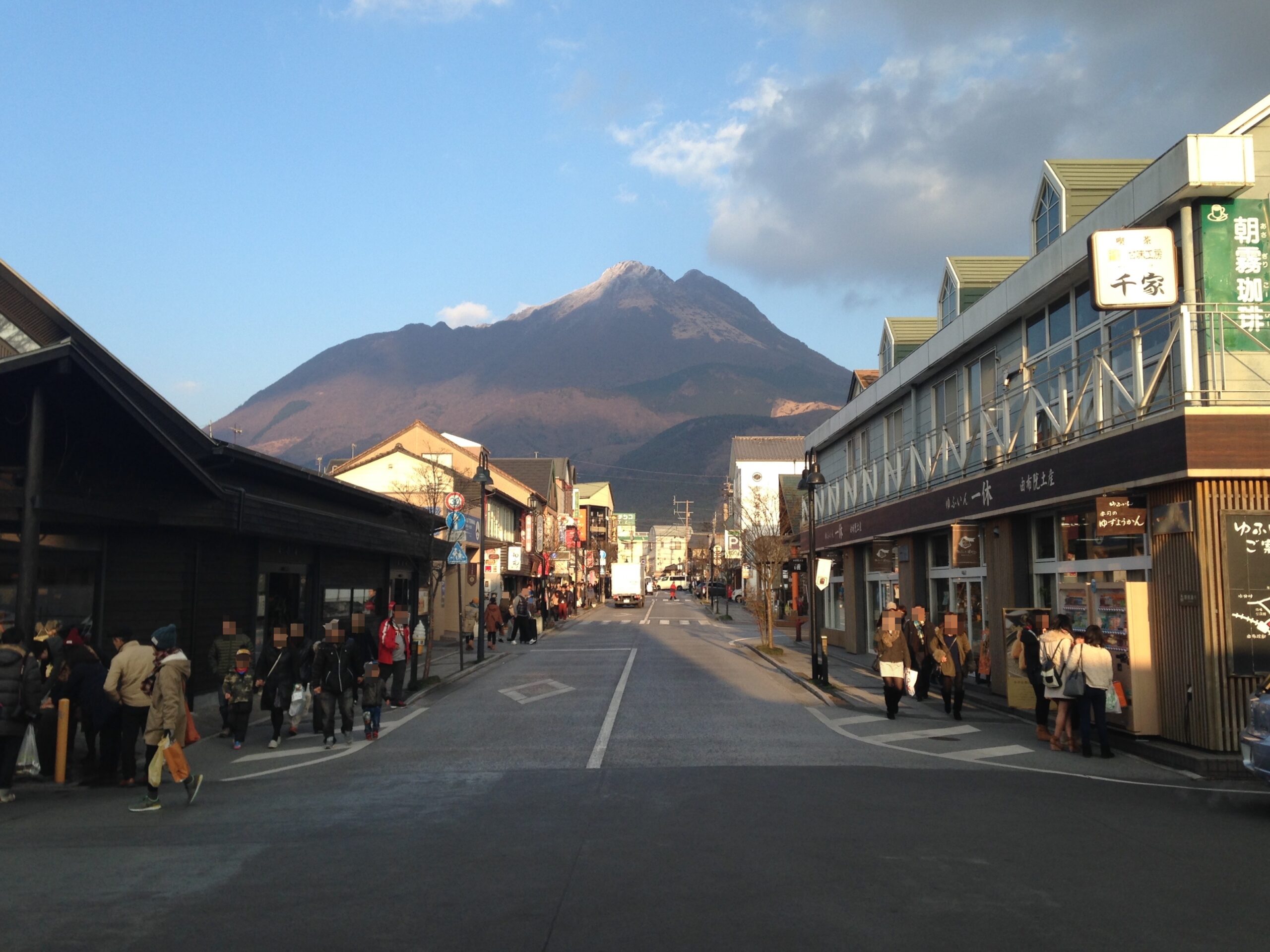
Late morning — walk up Yunotsubo Kaidō. Drop your bags at your inn (most will hold luggage before check-in; ask when you book), then walk the main street toward the lake. This is the street at its liveliest: snack stalls, craft shops, cafés and galleries, with Mount Yufu closing the view. Have lunch here — the street is built for grazing — and do your souvenir browsing now, not tomorrow, when the morning belongs to the lake.
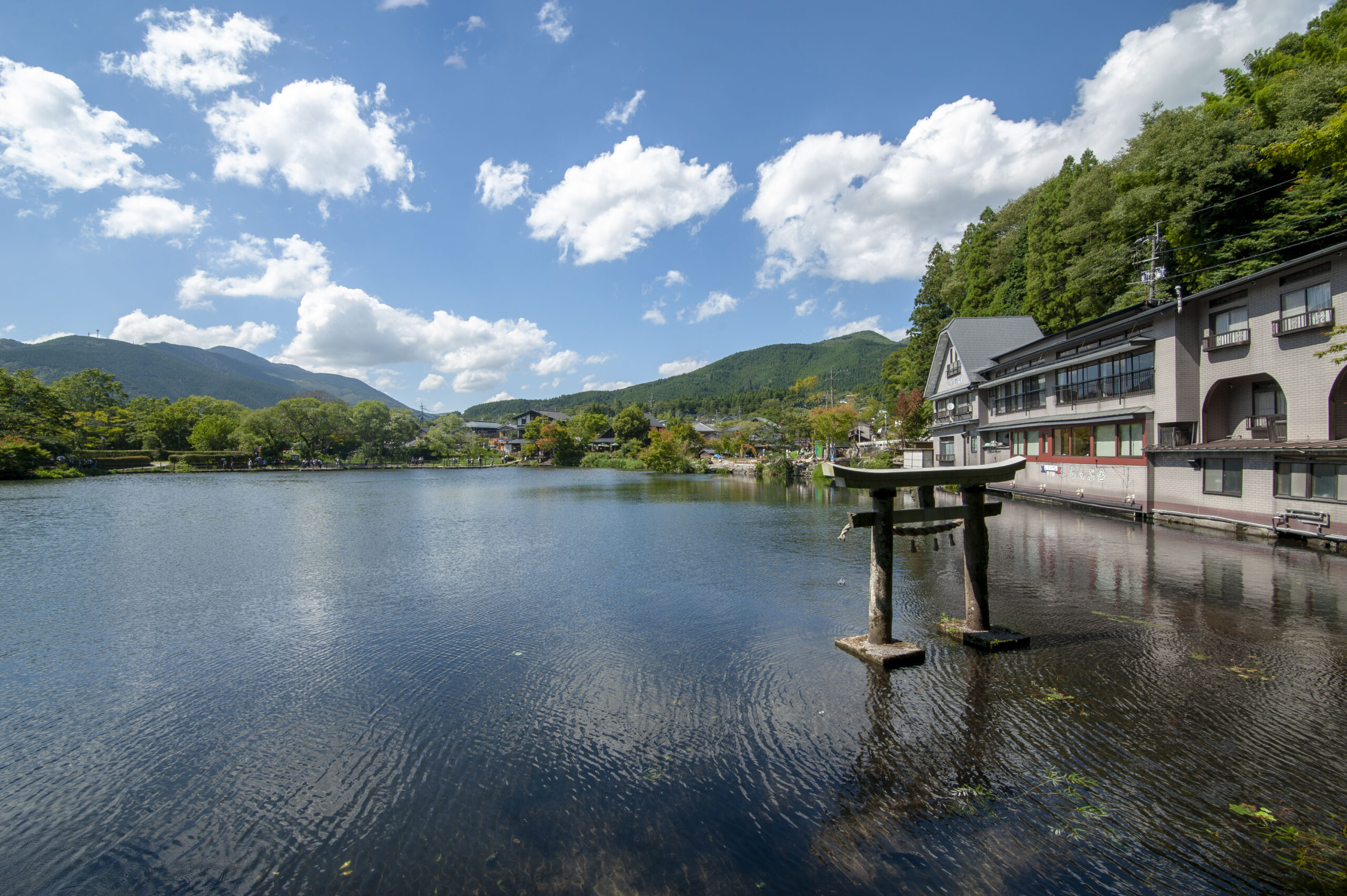
Afternoon — Lake Kinrin, slowly. The street ends at Lake Kinrin, a small lake about 25 minutes on foot from the station, circled by a walking path of roughly 400 metres. Fresh spring water and hot-spring water both flow into it, keeping it warm all year — the reason for the dawn steam you will come back for tomorrow. A small shrine gate stands in the water near the shore; the name “golden scales” is said to come from a Confucian scholar who saw its fish scales glittering gold in the evening sun. Give the afternoon no structure beyond the loop of the lake, a café, and a slow walk back through the residential side lanes.
Evening — the inn. Check in, and let the evening be the ryokan’s: a bath, dinner, a second bath, an early night. The payoff comes at dawn.
Day 2: Beppu — Lake Kinrin at Dawn, Then Choosing Your Hells
Dawn — Lake Kinrin before breakfast. Walk to the lake early. On cold mornings — late autumn through winter is the season — steam rises off the warm water and the gate stands in a white haze. It is weather-dependent, never guaranteed; on a mild morning you get the lake at its calmest hour instead. This is the hour day-trip visitors never see — and the whole reason this plan sleeps in Yufuin. Walk back for breakfast and check out.
Late morning — a last pass along the street, then move to Beppu. A coffee and a final look at the mountain as the shops reopen, and then it is time to move. The scenic option is Yufuin no Mori No. 3, leaving Yufuin at 12:32 and arriving at Beppu at 13:31 (reserved seats; it does not run on every date — check the operating calendar). The flexible option is Kamenoi Bus’s local No. 36 from Yufuin Station-mae Bus Center to Beppu Station, running through the day and taking about an hour. One warning: many older guides recommend the “Yufurin” sightseeing bus between the towns. Kamenoi Bus suspended it in October 2026 — check the company’s site for the current position.
Afternoon — choose your Hells (Kannawa). From Beppu Station, take a city bus up to Kannawa, where five of the seven Hells sit within walking distance of one another. All seven open 08:00–17:00, every day. Rather than attempting all seven, choose three or four of the Kannawa five and take them slowly:
- Umi Jigoku (Sea Hell) — the largest and most garden-like: a milky cobalt-blue pond wreathed in steam. If you see only one Hell, make it this one.
- Oniishibozu Jigoku — grey mud bubbles that swell and pop like the shaven heads of monks (bōzu), which is where the name comes from.
- Kamado Jigoku — a lively, varied site with several small ponds of different colours.
- Shiraike Jigoku — a milky white-blue pond in a Japanese garden, the gentlest of the group.
- Oniyama Jigoku — a powerful spring whose steam was once used to breed crocodiles, which are still kept there.
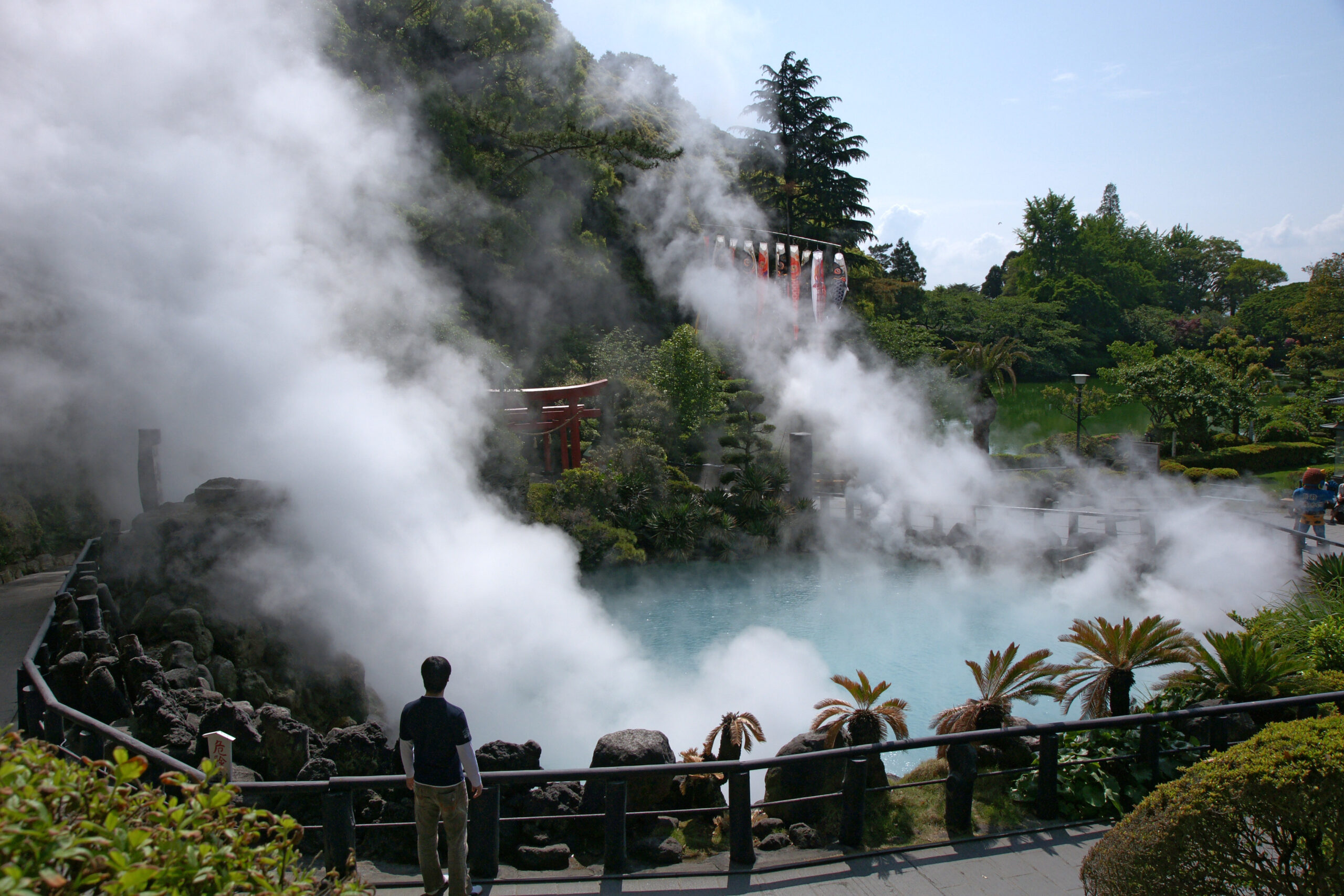
The two remaining Hells — Chinoike Jigoku, a blood-red pond, and Tatsumaki Jigoku, a geyser that spouts at intervals — are in the Kamegawa district, a further bus ride away. Add them only if the afternoon is going easily; they are the ones to leave for another trip.
On tickets: the common ticket covering all seven Hells costs ¥2,400 for adults (¥1,200 for school-age children), is sold at every Hell, admits you once to each, and stays valid for two days; individual entry is ¥500 per Hell. At three or four Hells, individual tickets are cheaper; at five or more, the common ticket wins — and its two-day validity lets an unfinished Hell wait for a Beppu morning.
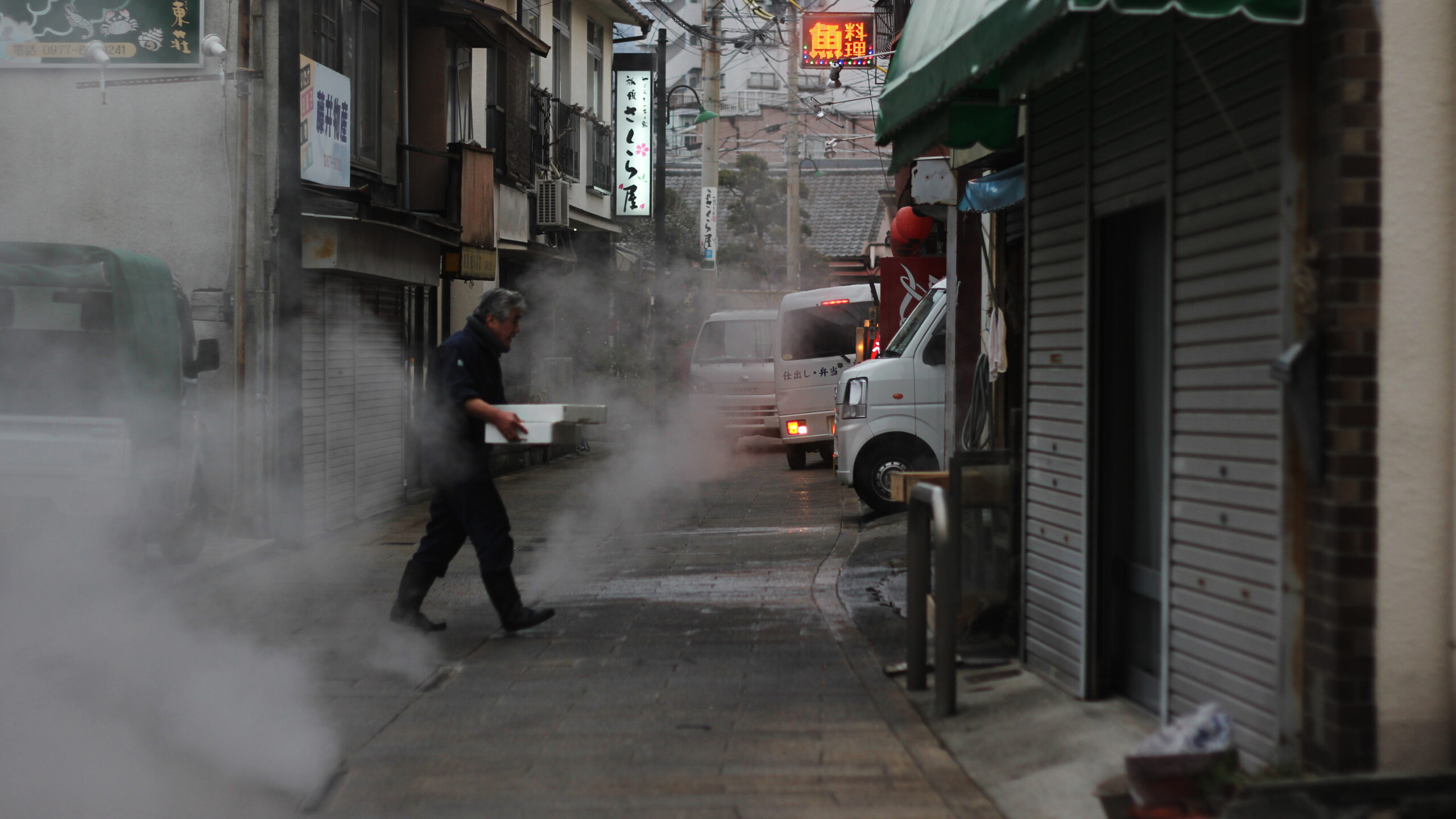
End of the day — Kannawa’s steam. Finish in Kannawa itself, not at another ticket gate. As the light goes, walk the stone lanes where steam rises from drains and between houses. If you have the energy for one more bath, the municipal Kannawa Mushiyu (admission ¥700) is the most distinctive in town: you lie on fragrant sekishō herbs over a stone floor heated by spring steam — a tōji tradition the city traces to 1276 and the monk Ippen. Its hours change with the season, so check them on the day. Buses run back down to Beppu Station; limited expresses connect Beppu to Hakata via Oita into the evening (about two hours), or stay the night in Beppu and give its baths a day of their own.
Getting There
- From Hakata by train (the scenic route): JR Kyushu’s Yufuin no Mori runs two round trips a day between Hakata and Yufuin, plus one that continues to Beppu (timetable as of January 2026). All seats are reserved. Reservations open at 10:00, one month before the travel date, through the JR-KYUSHU Train Reservation site and station ticket offices. The regular one-way fare from Hakata to Yufuin was ¥6,130 (base fare plus reserved-seat charge) when checked in November 2026; the charge varies by date, so confirm when booking. If it is sold out, fallbacks are the limited express Yufu (which runs the same timetable on the Yufuin no Mori’s non-operating days), the route via Kokura and Oita that JR itself suggests, or the highway bus below.
- From Fukuoka by highway bus (the easy-to-book route): The Yufuin-go runs from Nishitetsu Tenjin Highway Bus Terminal and Hakata Bus Terminal — also calling at Fukuoka Airport’s international terminal — to Yufuin Station-mae: about 2 hours 25 minutes from Tenjin, 14 round trips a day, ¥3,250 one way (web early-booking fare ¥2,880 on limited seats). Seats are reserved and must be booked, from 08:00 one month ahead. With far more departures than the train, this is the practical choice when the Yufuin no Mori has gone.
- Between Yufuin and Beppu, and getting around: Yufuin no Mori No. 3 (Yufuin 12:32 → Beppu 13:31) on the days it runs, or Kamenoi Bus local No. 36 between Yufuin Station-mae Bus Center and Beppu Station, about an hour, running through the day. The Yufurin sightseeing bus was suspended in October 2026 — see Day 2 above. In Beppu, city buses link the station with Kannawa and the Hells; the five Kannawa Hells are walkable one to the next, the two Kamegawa Hells need a bus. In Yufuin, everything is on foot.
Respectful Travel
An onsen town is where people live, work and take the waters for their health — not a theme park. A few basics (our Travel Essentials guide covers onsen etiquette in full):
- Before you bathe: Wash your whole body at the washing stations before entering the tub, and rinse off soap completely. The bath is for soaking, not washing. Keep towels and hair out of the water — tie long hair up, and leave your towel on the side of the bath.
- In the water: Enter slowly — the water can be very hot — and keep voices low. Swimwear is not worn in ordinary baths, and photography inside bathhouses is prohibited.
- Tattoos: Policies vary. Some public baths still do not admit tattooed bathers; many ryokan are more flexible, and a private bath at your inn avoids the question entirely. Check the policy in advance rather than at the door.
- At the Hells: The springs are near-boiling and the barriers are there for good reason. Stay on the paths, never reach toward the water, and keep a close hand on children.
- In the lanes: Kannawa’s back streets and Yufuin’s side lanes are residential. Keep noise down, do not peer into homes or gardens, and remember that the steam and the source wells are part of local livelihoods — look, photograph from the street, and take nothing away.
Practical Tips
- Do the ticket maths before you queue. As worked out in Day 2: the ¥2,400 common ticket only beats ¥500-per-Hell tickets from the fifth Hell — unless you use its two-day validity to split the Hells across two days.
- Book in this order: the train first (the day reservations open, a month ahead), then the inn. The Yufuin no Mori is the one element of this trip that genuinely sells out.
- Luggage: You change base once, so travel with a bag you can carry onto a local bus without resenting it. Both stations have coin lockers; most inns hold bags if you ask when booking.
- Staying put versus moving: Two nights in one town and a day trip to the other is easier on luggage, and Beppu makes a fine base. What it costs you is Yufuin at dawn — the lake in the early morning belongs to people sleeping in Yufuin. This plan spends the night where the dawn is.
- Check before you go: JR Kyushu’s operating calendar (Yufuin no Mori Nos. 3 and 4 do not run daily), Kamenoi Bus for the current Yufuin–Beppu bus position, the Beppu Jigoku Association for hours and prices, and Beppu City for Kannawa Mushiyu’s current hours, which change with the season. In summer, carry water for the Hells — the paths around the springs are hot work.
FAQ
Should I stay in Yufuin or Beppu?
For this plan, Yufuin — because Lake Kinrin at dawn cannot be reproduced as a day trip. Beppu offers more choice of places to stay and the easier onward journey; a second night there suits a second day of baths. What we would not do is move twice in two days.
How many of the Hells should I see?
Three to five. Umi Jigoku alone if you truly have one stop; Umi, Oniishibozu and Kamado make a satisfying Kannawa trio; add Shiraike and Oniyama if the pace is easy. All seven is possible, but for most people the seventh spring adds less than the slow hour in Kannawa that it costs.
Do I need a car?
No. This plan is designed around trains and buses, and both towns are walkable once you arrive. A car makes rural ryokan and the Kamegawa Hells easier, at the cost of mountain roads and town parking.
Can I do Yufuin and Beppu as a day trip from Fukuoka?
You can, but you will see the busiest version of both towns and neither of the hours this plan is built around — dawn in Yufuin, dusk in Kannawa. If one day is all you have, choose one town and do it properly: Yufuin for the lake and the inn-town feel, Beppu for the Hells and the steam.
Last Verified
Facts in this article were checked on 28 November 2026 against the following sources:
- JR Kyushu official site (English), “YUFUIN NO MORI” — all-reserved seating, timetable as of January 2026 (No. 1 Hakata 09:17 → Yufuin 11:31; No. 3 Yufuin 12:32 → Beppu 13:31), operating-day calendar, booking via JR-KYUSHU Train Reservation, and JR’s notice that seats are consistently fully booked: https://www.jrkyushu.co.jp/english/train/yufuin_no_mori.html
- Nishitetsu official site — Fukuoka / Fukuoka Airport to Yufuin highway bus “Yufuin-go”: reserved seats, 14 round trips a day, about 2 hours 25 minutes from Tenjin, ¥3,250 one way (web early fare ¥2,880), reservations from 08:00 one month ahead: https://www.nishitetsu.jp/bus/highwaybus/rosen/yufuin/
- Beppu Jigoku Association official site, Business Information — the seven Hells, hours 08:00–17:00 open every day, common ticket ¥2,400 / ¥1,200 in force from 1 February 2025, valid two days, one entry per Hell, sold at every Hell: http://www.beppu-jigoku.com/fee/
- Oita Prefecture official tourism site (Tourism Oita) — individual Hell admission ¥500 / ¥250 and the common ticket prices: https://www.visit-oita.jp/spots/detail/9215
- Yufu City official site — Lake Kinrin: spring water and hot-spring water flowing in, warm water all year, steam on winter early mornings, origin of the name: https://www.city.yufu.oita.jp/kankou/kankou-2/kankou_cate1_1/kinrinko
- Beppu City official site — Kannawa Mushiyu: founded in 1276 by the monk Ippen, stone chamber with sekishō herbs over a steam-heated floor, seasonal hours notices: https://www.city.beppu.oita.jp/sisetu/shieionsen/detail11.html
- Kannawa Onsen official site — Kannawa Mushiyu admission ¥700, free outdoor foot-steaming: https://kannawaonsen.com/onsen/
